Key Takeaways
- ✓ Patients arriving at a periodontal website are often anxious or uncertain — clarity and calm matter as much as content.
- ✓ Most patients do not know what a periodontist does — the website should explain it in accessible, reassuring language.
- ✓ Organizing services around patient concerns (not procedure names alone) reduces confusion and drives more appointment requests.
- ✓ Local SEO for specialty dental practices starts with specific service pages, not just a homepage.
When someone arrives at a periodontist's website, they are usually carrying a question they are not quite sure how to ask. A dentist has referred them. They noticed their gums bleeding. They have been told they have bone loss, gum recession, or periodontal pockets. They are missing a tooth and wondering whether they are a candidate for an implant.
In most cases, they are not comparison shopping between specialists the way someone might browse restaurants. They are trying to understand what is happening with their health, whether this practice can help them, and what the process of getting that help looks like. They may be anxious about cost, about discomfort, or simply about the unfamiliar.
That is the context in which periodontist website design needs to be evaluated. Not just: is this site up to date? But: does this site meet a worried patient where they are — and give them a clear, calm path forward?
Specialty Dental Patients Need Clarity First
A significant portion of patients who land on a periodontal practice website have never seen a specialist before. They may not know the distinction between a general dentist and a periodontist. They may not be sure whether their situation warrants specialty care at all.
A well-designed periodontal website should answer the foundational questions early:
- What is a periodontist, and how is this different from my regular dentist?
- What conditions does this practice treat?
- Do I need a referral, or can I contact the office directly?
- What will happen at my first visit?
- How do I reach out or request an appointment?
These are not complex marketing problems — they are clarity problems. The specialty is real and the expertise is substantial, but if the website assumes a level of familiarity that most patients do not have, it creates unnecessary friction before the first call is ever made.
The Website Should Organize Services Around Patient Concerns
Most specialty dental websites organize services by procedure name — which makes clinical sense but does not always match how patients think about their situation. A patient who is worried about their gums does not necessarily know whether they need scaling and root planing, pocket reduction surgery, or LANAP therapy. What they know is the symptom.
Consider the way patients typically describe their concerns when they call:
- "My gums bleed when I brush and my dentist said I need to see a specialist."
- "I have gum recession and my teeth are starting to look longer."
- "I am missing a tooth and want to understand what my options are."
- "My dentist told me I have bone loss and I want a second opinion."
- "I have loose teeth and I do not know what to do."
- "I was told about LANAP but I want to understand what it actually is."
- "I had gum disease a few years ago and I need maintenance but I moved here."
A website for periodontal and dental implant care that acknowledges those entry points — rather than leading immediately with procedure lists — connects with patients more quickly. It signals that the practice understands what brings people in, not just what it is capable of performing.
This does not require rewriting every service page. Sometimes it is as simple as adding a brief section to the homepage that says, in plain language: if any of these situations sound familiar, we can help.
Dental Implant Pages Need More Than Procedure Names
Dental implants are one of the most searched topics in specialty dentistry, and patients researching them tend to have specific questions that go well beyond "what is an implant." They want to know whether they are a candidate. They want to understand the evaluation process. They want to know what role gum and bone health plays in the treatment — and why seeing a periodontal specialist for implant planning is different from having the procedure done by a general dentist.
Dental implant website design for a specialty practice should reflect that the practice is not just placing implants — it is evaluating the underlying structures that make implant treatment possible. That distinction is worth communicating clearly.
A well-structured implant page might walk through:
Initial evaluation
Assessment of gum and bone health to understand what foundation exists and what may need to be addressed first.
Treatment planning
A personalized plan based on the individual's anatomy, health history, and goals — not a standard package.
Implant placement
The surgical phase, explained in accessible language without overpromising outcomes.
Coordination with the restorative dentist
Many patients do not realize that implant treatment often involves both a specialist and their general dentist. Explaining this helps set expectations.
Follow-up care
What monitoring and maintenance look like after treatment.
The goal is not to replace the consultation — it is to prepare the patient for it. A patient who arrives informed and with realistic expectations is easier to serve than one who arrives with assumptions shaped by a marketing brochure.
Trust Comes Before the Appointment Request
Specialty healthcare is different from most local service categories when it comes to the trust required before someone takes action. A patient considering a periodontal evaluation or dental implant consultation is not making a low-stakes decision. They are asking themselves whether this is the right doctor, whether the practice understands their situation, and whether they will be treated with care.
The trust signals that matter most on a periodontal website include:
Doctor expertise and focus
A clear explanation of the specialist's training, board certifications, areas of focus, and any continuing education or professional involvement. Patients want to know who they are seeing.
What to expect at the first visit
Walking the patient through the consultation process — what happens, how long it takes, what they will learn — reduces anxiety and lowers the barrier to booking.
Patient testimonials and experience
Specific accounts from real patients, particularly those who came in with concerns similar to the reader's, carry significant weight. Generic five-star ratings are less convincing than a sentence that describes what a patient actually experienced.
Financial transparency
Cost and insurance are often the unspoken reason patients delay care. A brief explanation of financial options, payment plans, and what the first visit involves financially removes a major hesitation.
Calm, medically careful language
Patients are sensitive to overselling. Language that acknowledges individual variation, emphasizes evaluation, and avoids promises builds more credibility than language that implies guaranteed outcomes.
Clear referral pathway
Many periodontal patients are referred by their dentist. A short section acknowledging that path — and explaining how the practices coordinate care — reassures both patients and referring dentists.
None of these require elaborate design. They require the right content, placed where patients are still deciding — which is usually the first half of the homepage.
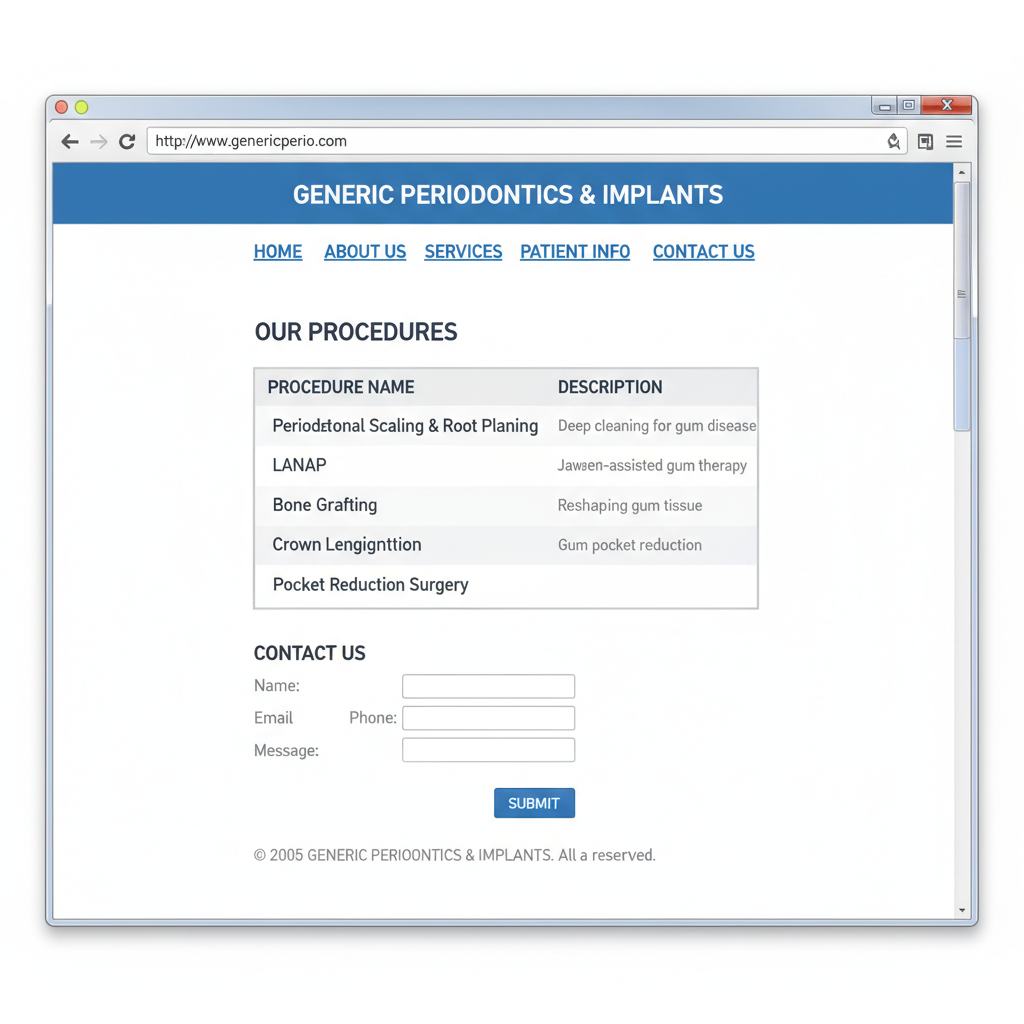
A Local Periodontal Website Redesign: A Concept Example
While reviewing the online presence of a local periodontal and dental implant practice, we noticed something that comes up often with established specialty healthcare providers: the practice had meaningful expertise — years of experience, a full range of periodontal services, advanced treatment options including LANAP laser therapy, and a track record of treating patients across multiple locations.
But the website experience, while informative, organized that expertise primarily around procedure names and clinical categories. For a patient arriving with a referral slip and a vague sense of concern about their gums, the path from landing on the site to understanding what would happen next was not immediately clear.
As a concept exercise, we redesigned the site with a few specific priorities in mind:
Patient-first homepage
The opening section was rewritten to acknowledge the reasons patients typically arrive — referral, gum concerns, missing teeth, recession — and to immediately signal that the practice handles all of it.
Services organized by condition
Each service was given its own section with a brief, plain-language description of what it addresses, when it might be recommended, and what the evaluation involves — without clinical overclaiming.
Patient journey section
A step-by-step overview of what happens from first contact through treatment and follow-up helps patients visualize the process and reduces the anxiety of the unknown.
Trust content near the top
Doctor credentials, treatment focus, and specialty distinction were moved from deep inside the site to the first scroll — where patients are still deciding whether to stay.
Medically careful language throughout
Every service description was written to emphasize evaluation and individual candidacy rather than outcomes, consistent with responsible healthcare communication.
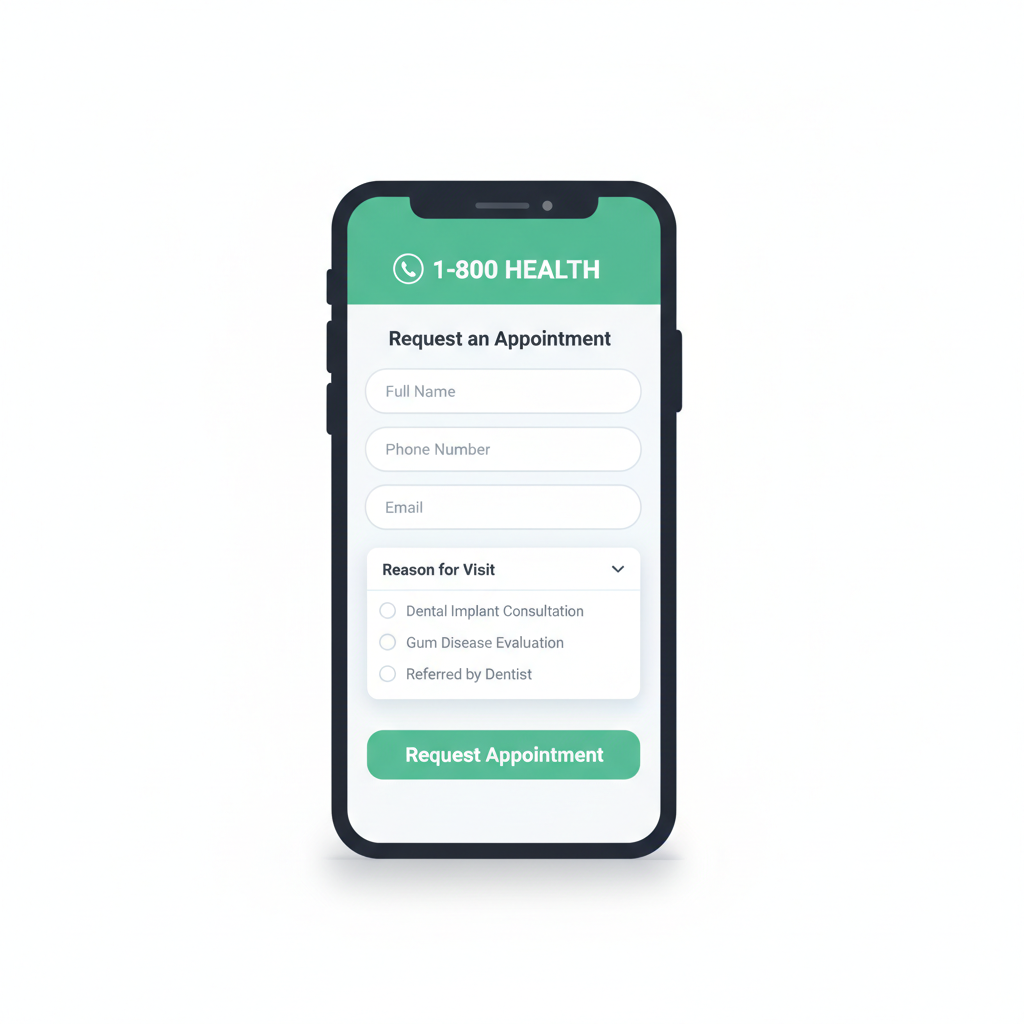
Simplified mobile contact flow
A short appointment request form — with pre-selected reasons for visit and a visible phone number in the header — made the path to reaching out significantly more direct on a phone.
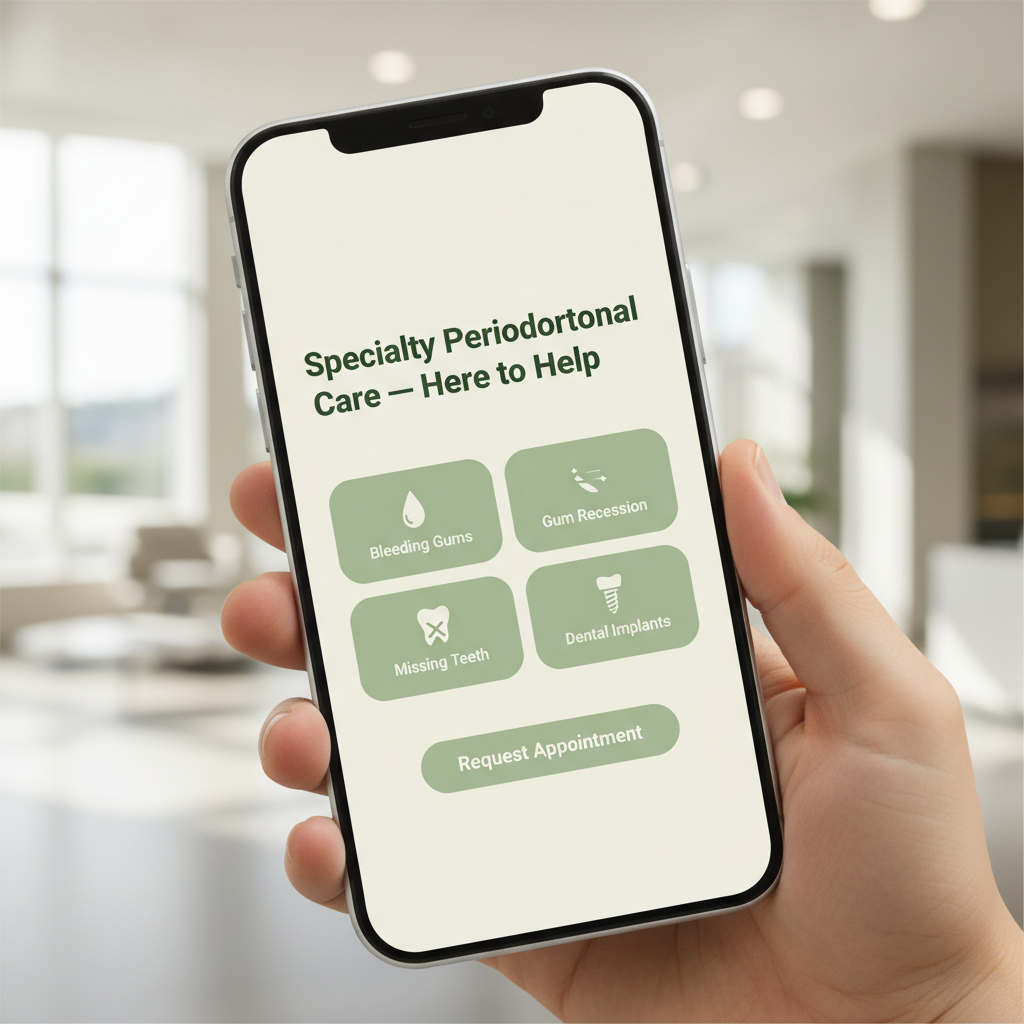
The underlying practice was already strong. The concept was simply about making that strength easier to see — especially for the patient who has never been to a specialist and is not sure what to expect.
What a Strong Periodontist Website Should Include
Periodontist website design does not need to be elaborate — but it does need to be complete. Here is a practical checklist for what a high-performing periodontal practice website typically includes:
Clear homepage headline: Who you are, what you specialize in, and where you practice — without requiring the patient to scroll to figure it out.
Visible phone number on mobile: In the header, tappable, and not buried behind a menu. The phone number is often the first thing a motivated patient looks for.
Request appointment button: Prominent, accessible without scrolling, and connected to a short form that works cleanly on a phone.
Patient-friendly explanation of periodontics: A brief section that explains the specialty in plain language for patients who may be unfamiliar with what a periodontist does.
Dental implant page or section: Not just a mention in a service list — a dedicated section covering evaluation, treatment planning, and what makes specialist-placed implants different.
Gum disease treatment page: Organized around what the patient may be experiencing, not just the procedures available.
LANAP or advanced treatment information: With clear language about candidacy and evaluation — not marketed as a universal solution.
Patient journey section: A step-by-step walkthrough of what happens from first contact through treatment, to reduce the anxiety of the unfamiliar.
FAQ section: Addressing the questions patients actually ask before scheduling: what to expect, whether a referral is needed, how long treatment takes, and financial options.
Reviews or patient testimonials: Specific, meaningful accounts from real patients — not generic ratings.
Financial options section: Brief, honest, and easy to find. Patients who cannot locate this information often delay care.
Mobile-first layout: Tested on an actual phone — not just responsive in theory.
Periodontist SEO Starts With Specific Service Pages
A homepage alone rarely generates meaningful local search traffic for a specialty dental practice. When someone searches "dental implants Ventura" or "LANAP treatment near me" or "periodontist for gum recession," Google is looking for pages that clearly address those specific topics in a specific location.
For a periodontal practice, that means developing content for each core service individually. Useful pages or sections for dental SEO and periodontist SEO include:
Location specificity matters too — particularly for a practice that serves multiple cities. Mentioning the cities, the local dental community, school districts, and nearby communities gives search engines more geographic context and signals relevance to local patients.
Dental implant marketing and periodontist marketing that relies solely on a homepage and a word-of-mouth reputation will always be limiting. The practices that appear consistently in local search have typically invested in content depth — not just a polished design.
Takeaway for Specialty Healthcare Practices
A periodontist website does not need to overwhelm patients with clinical detail. It needs to do something more difficult: help a patient who may be anxious, unfamiliar with the specialty, and still deciding whether to call — feel like they are in the right place.
That means clear language, organized services, visible trust signals, and a path to the appointment that works on a phone. It does not mean making promises about outcomes or simplifying the medicine. It means presenting what the practice already does — thoughtfully and accessibly.
Periodontist website design that achieves this is not about aesthetics alone. It is about understanding the emotional state of the person on the other side of the screen and removing the obstacles between them and the care they need.
The specialty healthcare practices that do this well tend to see more inquiries, better-prepared patients, and stronger referral relationships — not because they oversold themselves, but because they made their expertise easier to understand and their practice easier to approach.
Frequently Asked Questions
Related Reading
- Website Design for Local Businesses — 530 Ventures
- Medical Practice Marketing: How Healthcare Businesses Grow Online
- Local SEO: How to Show Up When Patients Search
- Website Design: What It Costs and What Makes Sites Convert
- Dentist Digital Marketing in Camarillo — 530 Ventures
- Tutoring Website Design: How to Help Parents Choose Faster